Lights
Lights let you see and let others see you. But the wrong lights can dazzle and create danger.
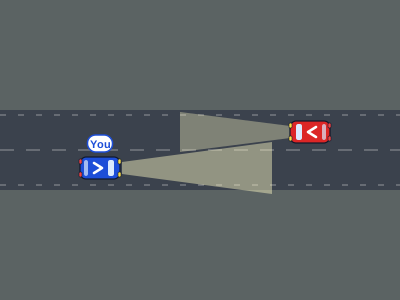
Which lights must be on?
- The required lamps and headlights must be on when you drive on a road, even in daylight.
- Dipped headlights are the main rule. In daylight daytime running lights are enough, but not in darkness, dawn, dusk or bad weather.
- Front fog lights may be used instead of dipped headlights in fog and heavy rain or snow, but not at the same time as dipped headlights.
- Rear fog lights may only be used in fog, heavy rain or snow or similar visibility, and not so that drivers behind are dazzled.
Source: Trafikförordningen 3 kap. 68, 69, 71 och 72 §§ · Legal text (Swedish): Road Traffic Ordinance (1998:1276) (opens in a new tab)
Main beam
Use main beam when you otherwise cannot see far enough for your speed. Main beam may not be used on a well-lit road, close to an oncoming vehicle that may be dazzled, when meeting trains or boats alongside the road if there is a risk of dazzle, or close behind another vehicle.
Source: Trafikförordningen 3 kap. 70 § · Legal text (Swedish): Road Traffic Ordinance (1998:1276) (opens in a new tab)
When the car is parked
When the car is standing on the road in darkness, the parking lights and rear lights must be on. This is not needed if the road is so well lit that the car is clearly visible, or if the car is outside the carriageway and hard shoulder.
Source: Trafikförordningen 3 kap. 74 och 75 §§ · Legal text (Swedish): Road Traffic Ordinance (1998:1276) (opens in a new tab)
Colours and flashing lights
To the front the car may only show white or yellow light. White light to the rear may only be shown when reversing. Flashing lights may only be used in, among other things, direction indicators and hazard warning lights.
Source: Trafikförordningen 3 kap. 76 § · Legal text (Swedish): Road Traffic Ordinance (1998:1276) (opens in a new tab)