Right of way
The right-of-way rules decide who has to wait. Anyone who has to give way must show it clearly in good time and may only continue when it can be done without danger or obstruction to others.
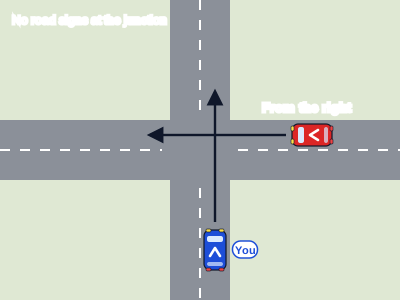
What does duty to give way mean?
If you have to give way, you must show it in good time by slowing down or stopping. You may only continue if you can do so without causing danger or obstruction to others, considering where they are, how far away they are and how fast they are going.
Source: Trafikförordningen 3 kap. 5 § · Legal text (Swedish): Road Traffic Ordinance (1998:1276) (opens in a new tab)
Which instruction applies first?
- A police officer's instructions take precedence over everything else.
- Traffic signals, road signs and road markings take precedence over the general traffic rules.
- A steady light in a traffic signal takes precedence over stop or give way signs.
Source: Trafikförordningen 2 kap. 2 och 3 §§ · Legal text (Swedish): Road Traffic Ordinance (1998:1276) (opens in a new tab)
The right-hand rule
When the paths of two vehicles cross and nothing else has been decided, you must give way to vehicles coming from the right.
Source: Trafikförordningen 3 kap. 18 § · Legal text (Swedish): Road Traffic Ordinance (1998:1276) (opens in a new tab)
The exit rule
You must give way to everyone whose path you cross when you drive out onto a road from, for example:
- a car park, a property or a petrol station
- a path, a private track or a similar exit road
- a cycle track, a pedestrian street, a walking-speed zone, a cycle street or off-road terrain
- a place where you have first crossed a footpath or cycle track
Source: Trafikförordningen 3 kap. 21 § · Legal text (Swedish): Road Traffic Ordinance (1998:1276) (opens in a new tab)
From the hard shoulder
When you drive out onto the carriageway from the hard shoulder, you must give way to the vehicles on the carriageway.
Source: Trafikförordningen 3 kap. 21 § tredje stycket · Legal text (Swedish): Road Traffic Ordinance (1998:1276) (opens in a new tab)
Priority road, motorway and roundabout
- When you join a priority road, motorway or expressway where there is no acceleration lane, you must give way to the traffic on that road.
- When you enter a roundabout, you must give way to vehicles already in the roundabout.
Source: Trafikförordningen 3 kap. 21 och 22 §§ · Legal text (Swedish): Road Traffic Ordinance (1998:1276) (opens in a new tab)
Stop
At a stop sign you must always stop completely at the stop line. If there is no stop line, you stop before you drive out onto the crossing road. After that the same rules apply as when giving way.
Source: Trafikförordningen 3 kap. 19 § · Legal text (Swedish): Road Traffic Ordinance (1998:1276) (opens in a new tab)
Clearing the way and pedestrians
- You must clear the way for emergency vehicles using sirens, and for trains and trams. Stop if necessary.
- At an uncontrolled pedestrian crossing you must give way to pedestrians who have stepped out or are just about to step out onto the crossing.
- At a cycle crossing you must give way to cyclists and class II moped riders who are on or just about to go out onto the crossing.
Source: Trafikförordningen 2 kap. 5 § och 3 kap. 61 och 61 a §§ · Legal text (Swedish): Road Traffic Ordinance (1998:1276) (opens in a new tab)