Parking and stopping
There is a difference between stopping and parking. In some places you may neither stop nor park, in others you may stop for a short while but not park.
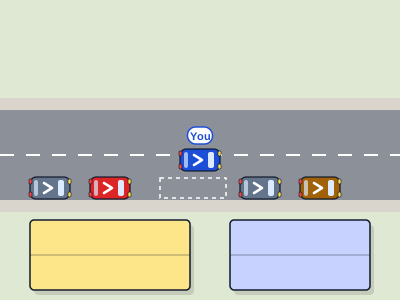
Stopping or parking?
Parking means leaving the vehicle standing, with or without a driver, for any reason other than that the traffic requires it, to avoid danger, or to let passengers on or off or load and unload goods.
Stopping means standing still with the vehicle for a reason other than the traffic or to avoid danger, when it does not count as parking. One example is dropping off a passenger.
Source: Förordningen (2001:651) om vägtrafikdefinitioner 2 § · Legal text (Swedish): Ordinance (2001:651) on Road Traffic Definitions (opens in a new tab)
Where on the road?
- You may only stop and park on the right-hand side in the direction of travel. On one-way roads you may also use the left-hand side.
- Place the vehicle as far from the centre of the carriageway as possible and lengthways along the road.
- Park off the carriageway if possible.
Source: Trafikförordningen 3 kap. 52 § · Legal text (Swedish): Road Traffic Ordinance (1998:1276) (opens in a new tab)
Here you may neither stop nor park
- on a pedestrian crossing, cycle passage or cycle crossing, or less than 10 metres before it
- in a junction or less than 10 metres from the nearest edge of the crossing carriageway
- on a crossing cycle track or footpath, or less than 10 metres before it
- in a tunnel or underpass
- on or near the top of a hill or a bend with limited visibility
- less than 3 metres from a solid line between lanes (if there is no broken line between the vehicle and the line)
- in a cycle lane, a hatched area, a roundabout or a bus lane
- on a footpath or cycle track (except for two-wheeled cycles and class II mopeds)
- on motorways and expressways, except in signed car parks and rest areas
Source: Trafikförordningen 3 kap. 48 och 53 §§ samt 9 kap. 1 och 2 §§ · Legal text (Swedish): Road Traffic Ordinance (1998:1276) (opens in a new tab)
Here you may not park
- less than 30 metres from a level crossing (crossing with a railway)
- in front of an entrance to a property
- on a priority road
- next to another vehicle standing at the edge of the carriageway (double parking)
- in a passing place
Source: Trafikförordningen 3 kap. 55 § · Legal text (Swedish): Road Traffic Ordinance (1998:1276) (opens in a new tab)
Bus stops
At a bus or tram stop you may only stop to let passengers on or off, and only if it does not obstruct the bus or tram. If the stop is not marked, the ban applies from 20 metres before to 5 metres after the bus stop sign.
Source: Trafikförordningen 3 kap. 54 § · Legal text (Swedish): Road Traffic Ordinance (1998:1276) (opens in a new tab)
Time limits and parking disc
- In public places in built-up areas and on public roads you may park for no more than 24 hours in a row on weekdays. This does not apply to weekdays that come before a Sunday or public holiday.
- If you use a parking disc, set it to the next half hour after you parked.
Source: Trafikförordningen 3 kap. 49 a § · Legal text (Swedish): Road Traffic Ordinance (1998:1276) (opens in a new tab)
When you leave the car
- Make sure the vehicle cannot start rolling and that no unauthorised person can drive off with it.
- Do not open the doors in a way that puts anyone else in danger.
- If the vehicle is on the carriageway or hard shoulder in darkness, dusk or dawn, the parking lights and rear lights must be on. This is not needed if the road is so well lit that the vehicle is still clearly visible.
Source: Trafikförordningen 3 kap. 50, 74 och 75 §§ · Legal text (Swedish): Road Traffic Ordinance (1998:1276) (opens in a new tab)