Road signs: groups and how long they apply
Road signs are divided into groups. If you recognise the group, you know at once whether the sign warns, gives a duty to give way, prohibits, requires or informs.
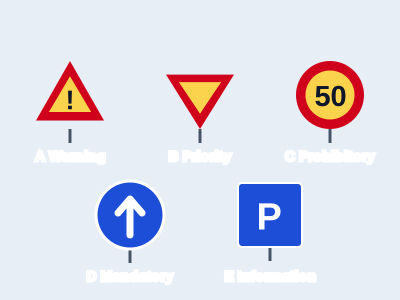
The groups
- A Warning signs warn of a danger and show what kind of danger it is.
- B Priority signs show give-way rules, for example give way, stop and priority road.
- C Prohibitory signs prohibit something, for example entry, overtaking or parking.
- D Mandatory signs show what you must do, for example which direction or track applies.
- E Information signs tell you what applies at a place or on a stretch of road, for example motorway, built-up area or parking.
- F–I Direction signs show the way and inform about, for example, hospitals, petrol stations and tourist attractions.
- J Additional information signs give other information, for example about a dangerous power line.
Source: Vägmärkesförordningen 2 kap. 1, 4, 6 och 11 §§ · Legal text (Swedish): Road Signs Ordinance (2007:90) (opens in a new tab)
Where the signs are placed
Road signs are placed on the right-hand side of the road unless otherwise stated. A prohibitory or mandatory sign placed above the carriageway only applies to the lane it is above.
Source: Vägmärkesförordningen 2 kap. 3 § · Legal text (Swedish): Road Signs Ordinance (2007:90) (opens in a new tab)
How long does a prohibition or requirement apply?
A prohibition or requirement applies from the sign up to the next junction. An exit from, for example, a farm or a car park does not count as a junction. The prohibition can end earlier, at an end sign or a sign with an additional panel with an arrow pointing down. If the prohibition also applies after the junction, the sign is put up again.
Speed limits are an exception. They apply until another speed is shown by a new sign.
Source: Vägmärkesförordningen 2 kap. 7–9 §§ · Legal text (Swedish): Road Signs Ordinance (2007:90) (opens in a new tab)
Information signs
An information sign applies from the sign to an end sign, for example End of motorway or End of built-up area.
Source: Vägmärkesförordningen 2 kap. 11 och 12 §§ · Legal text (Swedish): Road Signs Ordinance (2007:90) (opens in a new tab)
Additional panels
An additional panel under a road sign gives an extra instruction, for example the distance to what the sign applies to or the times it applies. If there are several panels under the same sign, each of them applies. An additional panel under a no-parking or no-stopping sign has a yellow background with black characters.
Source: Vägmärkesförordningen 2 kap. 2, 29 och 30 §§ · Legal text (Swedish): Road Signs Ordinance (2007:90) (opens in a new tab)